reharp 2.0
A capacitive touch instrument for music therapy, designed for people with limited mobility
Role
Designer and Engineer
Client
Nordoff Robbins
Year
2025
Type
Instrument design
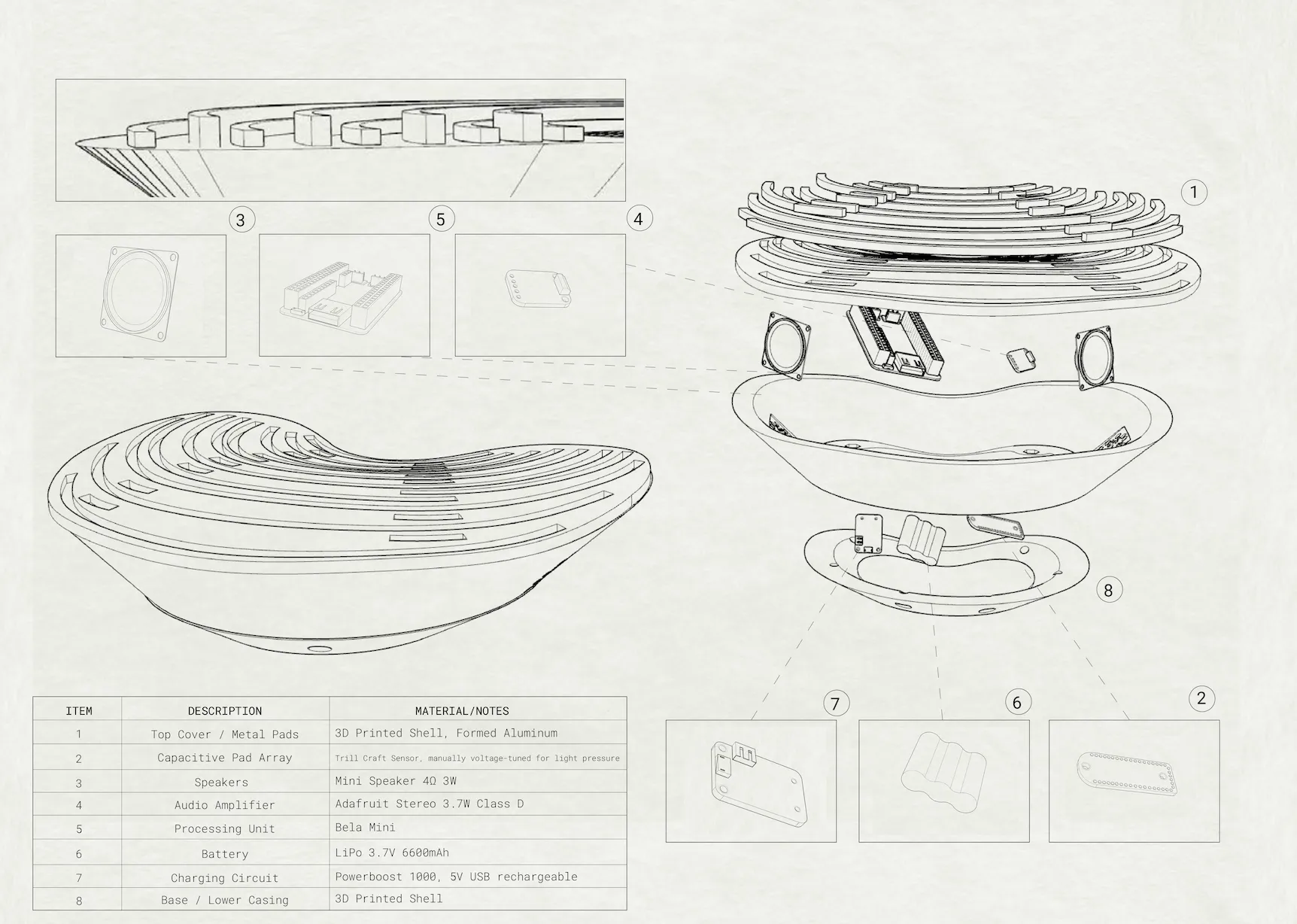
full system exploded view - Trill capacitive pad array, Bela Mini processing unit, stereo speakers, Class D amplifier, LiPo battery, 3D printed shell
overview
Reharp 2.0 is a capacitive touch instrument developed during a design research internship at Nordoff Robbins, one of the UK's leading music therapy organisations. The brief was to create an instrument that could be played by people with limited mobility, without requiring prior musical training, and without needing to be held in a fixed position.
The instrument responds to where and how the player touches its surface, translating contact into real-time audio through a custom C++ patch. It can be placed on a lap, held up, tilted, passed between two people. The position is part of the performance.
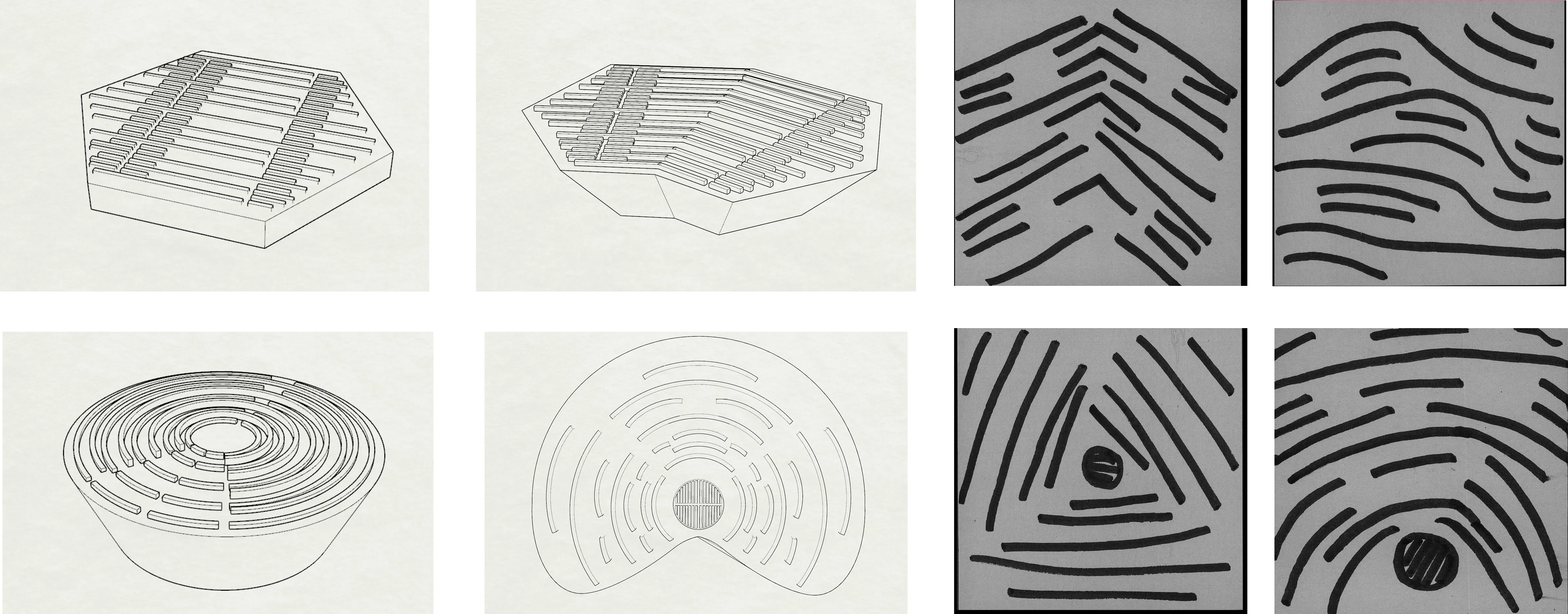
form development - hexagonal and circular instrument forms explored alongside tactile surface pattern studies for finger identification without looking
form and sensing
The form went through multiple directions before settling on the shell-like geometry of the final version. Hexagonal and circular layouts were both explored, each with different implications for how the instrument sits in the hands and how zones are arranged around a centre point. The tactile surface patterns were designed in parallel - grooves, ridges and raised lines that allow a player to locate zones by feel alone without needing to look down.
The capacitive pad array uses a Trill Craft sensor, with each pad manually voltage-tuned for light pressure response. This was the most time-intensive part of the build - getting the sensitivity right so the instrument responds to a fingertip touch without triggering from proximity alone.
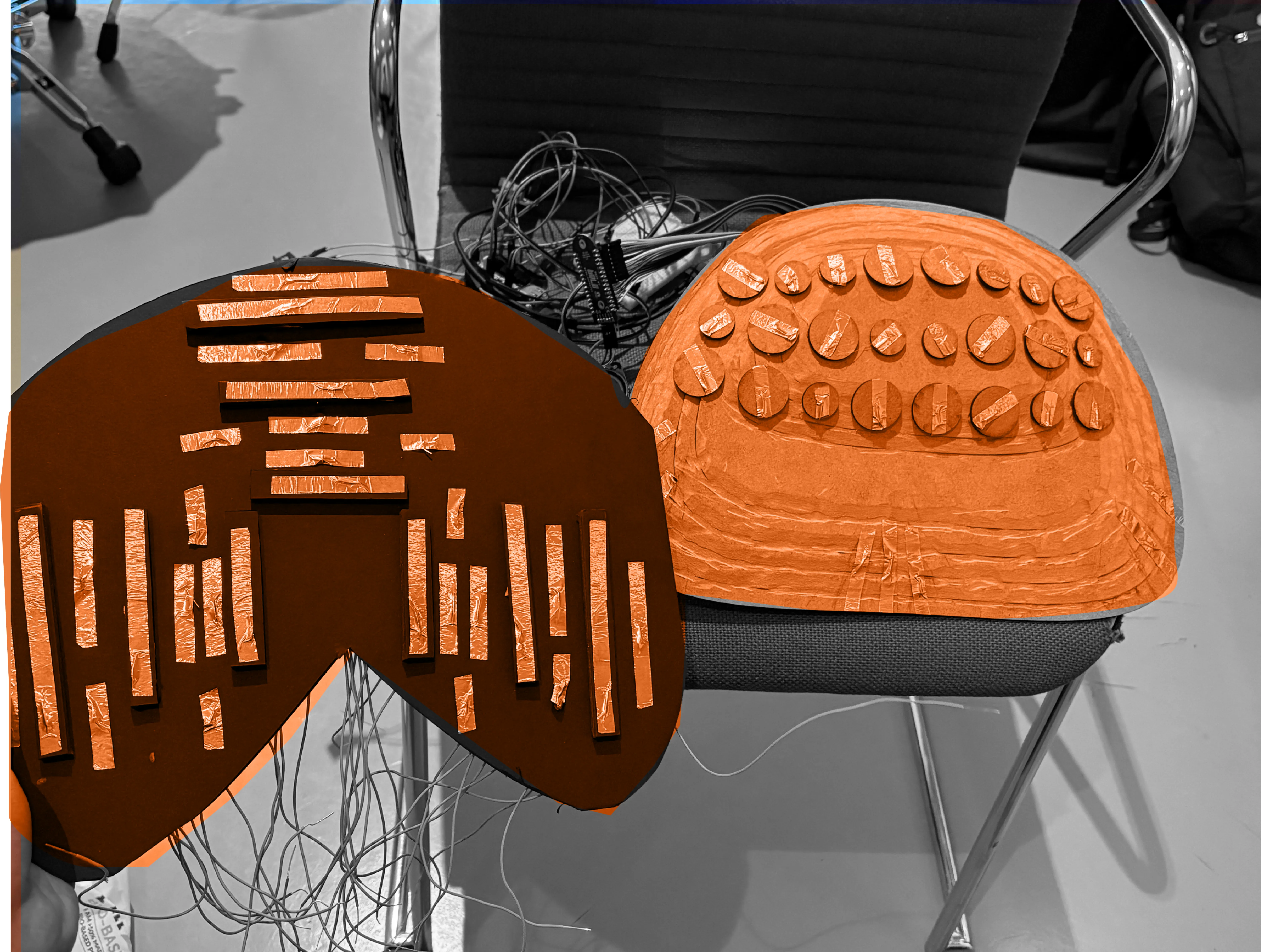
early physical prototypes - copper tape capacitive sensors laid by hand onto foam and card forms, wired directly to test sensing before committing to final geometry
hardware
The instrument is entirely self-contained. A Bela Mini handles real-time audio processing with sub-millisecond latency, running a custom C++ patch that classifies touch events and maps them to sound. Two 4-ohm 3W speakers sit inside the lower casing driven by an Adafruit Class D stereo amplifier. A 6600mAh LiPo battery powers the whole system over USB, rechargeable via a Powerboost 1000 circuit.
The shell is 3D printed in two halves - an upper cover housing the capacitive pad surface with formed aluminium pads, and a lower base containing all the electronics. The whole assembly is designed to be robust enough for repeated handling in a therapy context while still feeling considered as an object.
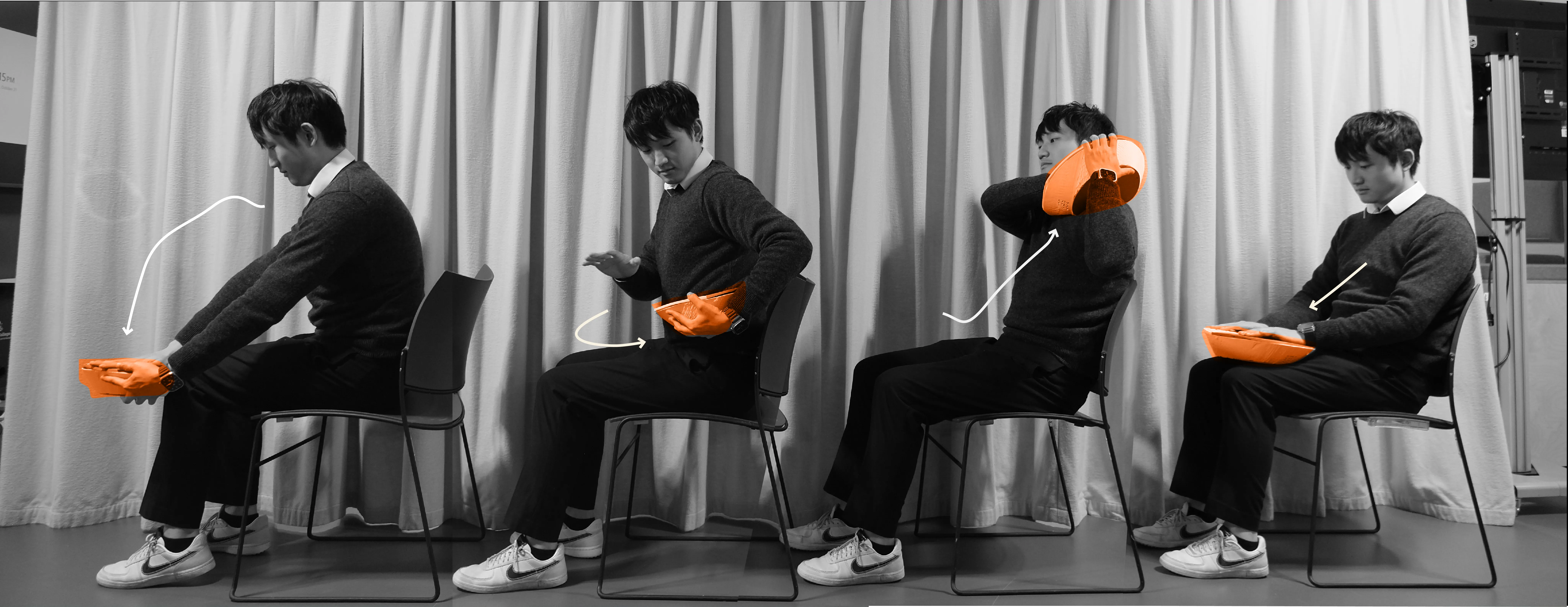
interaction study - the instrument played in four different positions with motion arrows showing orientation changes, testing accessibility across different postures and mobility levels
interaction
One of the key design decisions was that the instrument should work in any position. The interaction study tested four playing postures - held low and extended, rotated in the lap, raised to chest height, and rested flat. Each produced a different quality of playing because the relationship between the player's body and the instrument's surface changed. This variability is intentional: the therapy context requires flexibility.
The audio engine maps touch contact to timbre, volume and spatial positioning in real time. A therapist can reconfigure the sonic palette between sessions without touching the code.
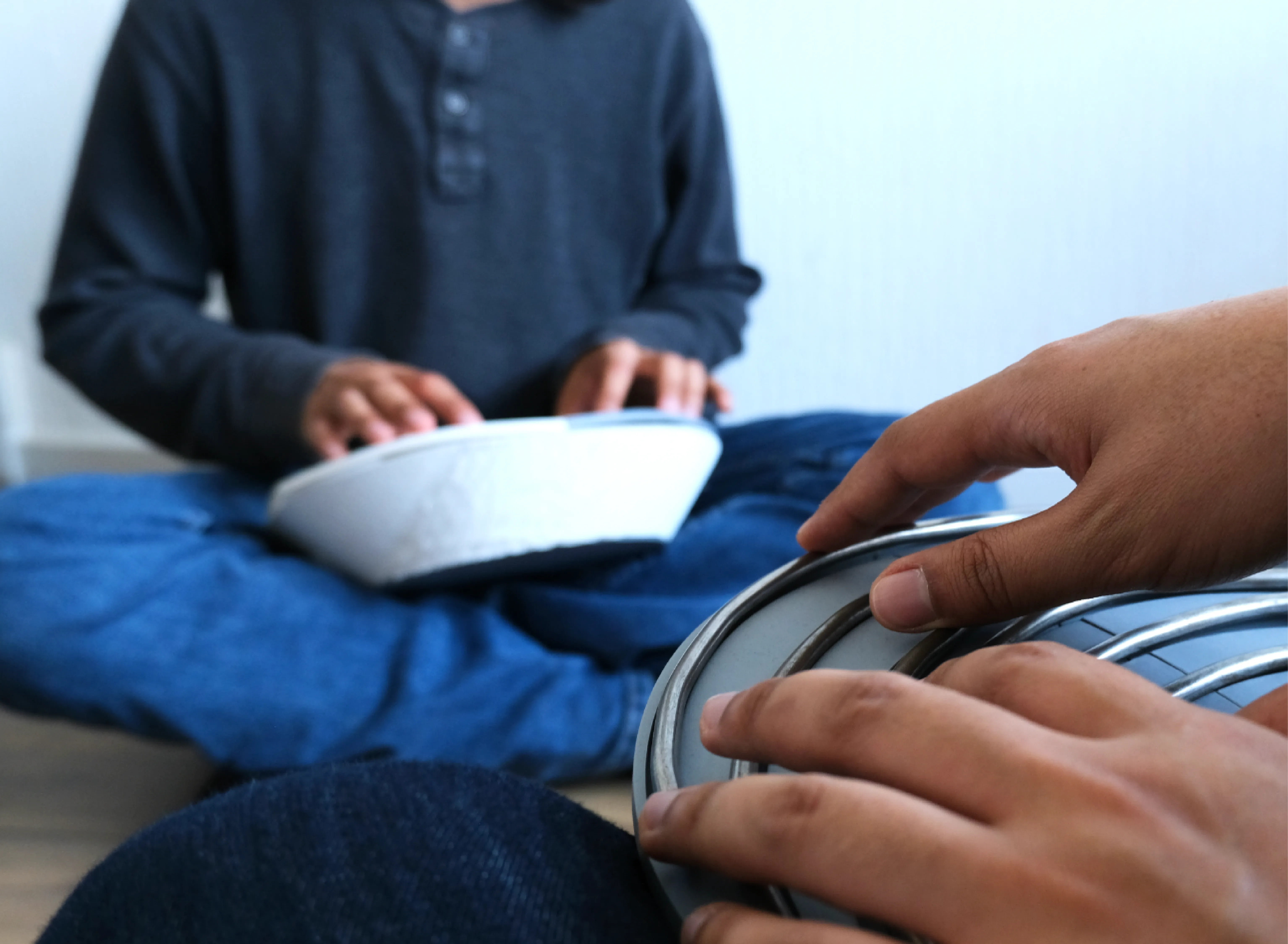
user testing session - two people playing together, the instrument passed between them, hands touching the surface simultaneously