tether(ar)
Spatial AR research using Snap Spectacles, exploring object recognition, hand tracking and new interaction models for physical space
Role
XR Researcher and Designer
Client
Snap x RCA
Year
2025 - present
Status
Work in progress
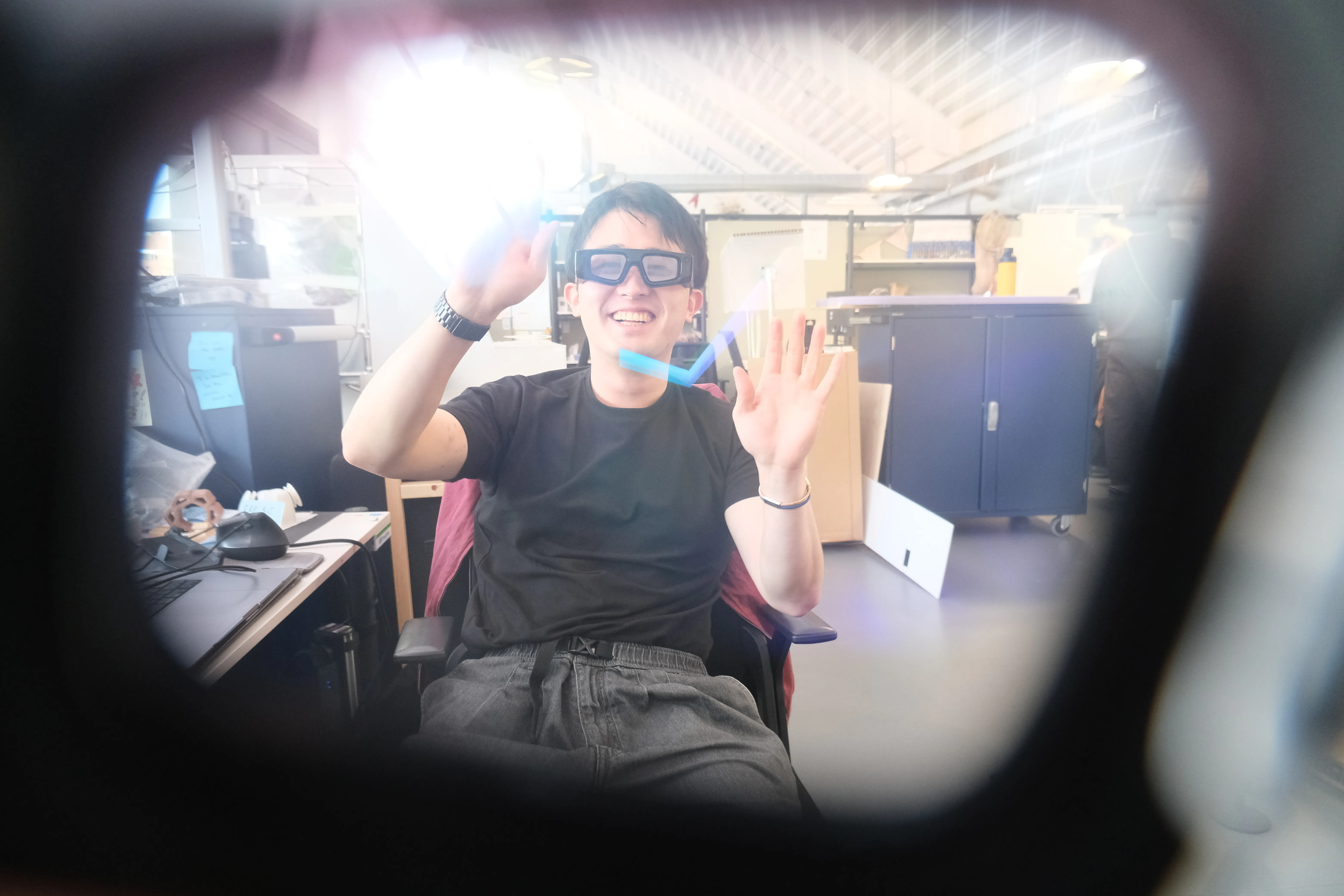
seen through the Spectacles lens, blue AR overlays responding to hand gestures in real space
overview
Selected as one of 48 designers from a competitive global pool to collaborate directly with Snap's XR team at the Royal College of Art, tether(ar) is an ongoing spatial AR research project built on Snap Spectacles. The work explores what AR can feel like when it responds to the physical world rather than sitting on top of it.
The central question driving the project: what does it mean to be tethered to digital information in physical space? The name comes from the idea of a signal that connects two points, stretching and distorting as the distance between them grows, never quite clean, never quite stable.
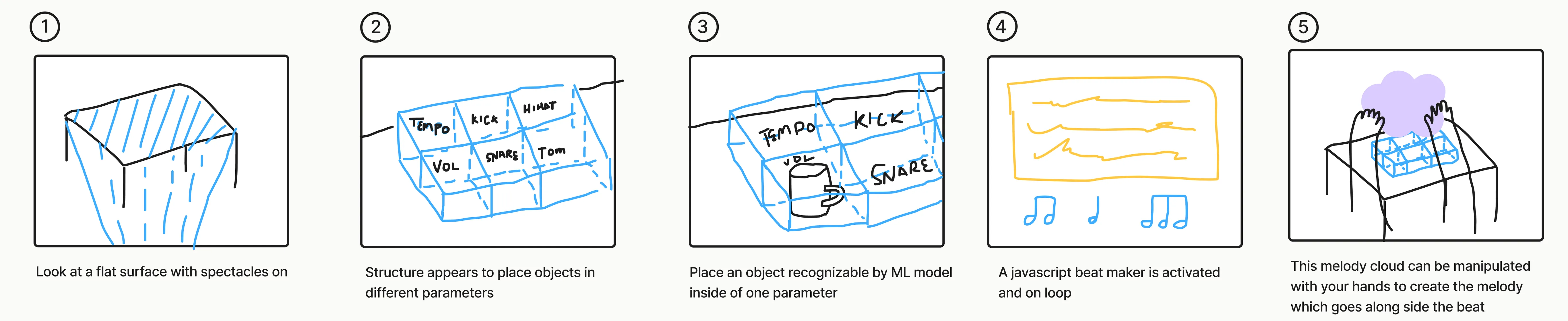
early concept drawings, the tether as a distorted signal between two people, hand gesture studies for spatial interaction
concept and research
The early research focused on what kinds of connection AR could make visible that are normally invisible: attention, presence, shared experience. The tether concept came from exploring how a signal degrades across distance, how information between two people gets distorted, compressed, misread.
The hand gesture studies explored how the body can become a controller without holding anything. Palms, fingers, orientation, all readable by the Spectacles without any additional hardware. This became central to the interaction model: the hands are the interface.
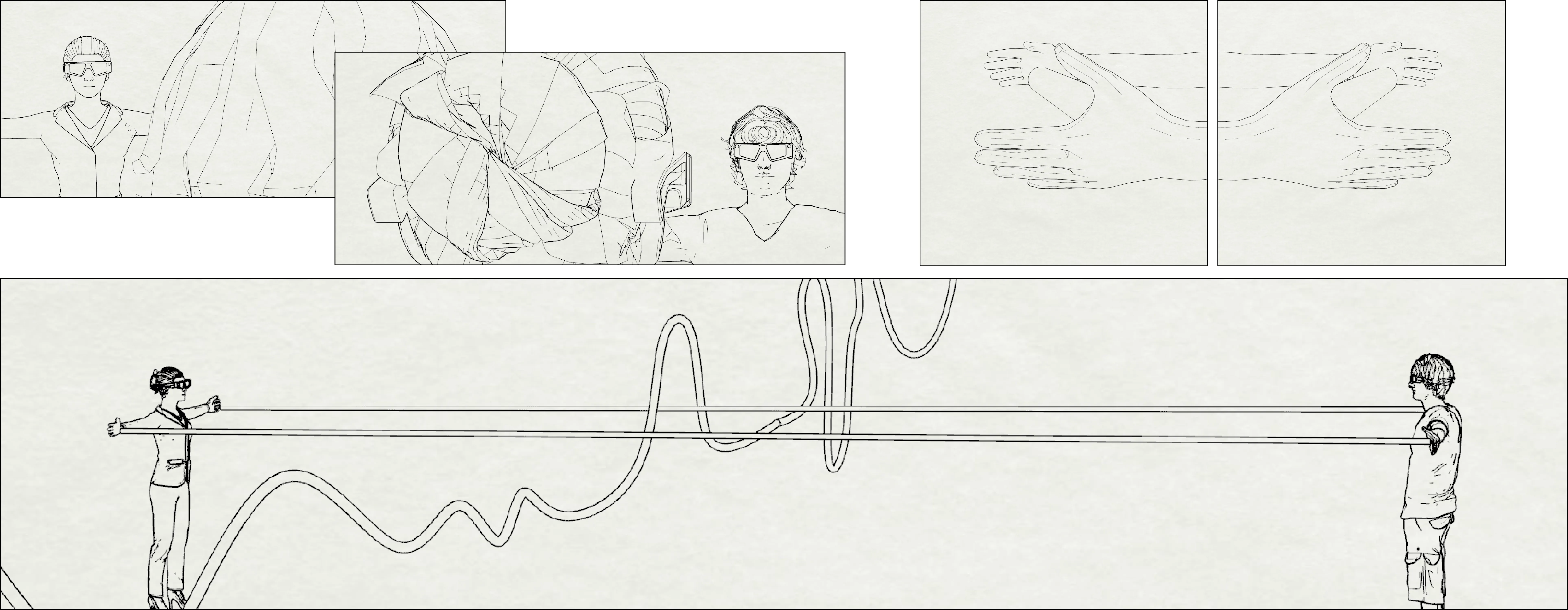
storyboard for a spatial beat-maker, look at a surface, place objects recognised by an ML model to set parameters, shape a melody cloud with your hands
interaction design
One direction explored using everyday objects as musical parameters. Point the Spectacles at a flat surface and an AR grid appears. Place a recognisable object inside a zone, a coffee cup, a phone, a book, and the ML model reads it, triggering a corresponding sound loop. A melody cloud materialises above the grid and can be shaped and stretched with both hands.
The interaction is designed around the idea that the physical world already contains enough information to make music. You just need something that can read it. The Spectacles become a lens that reveals a layer of the room that was already there.
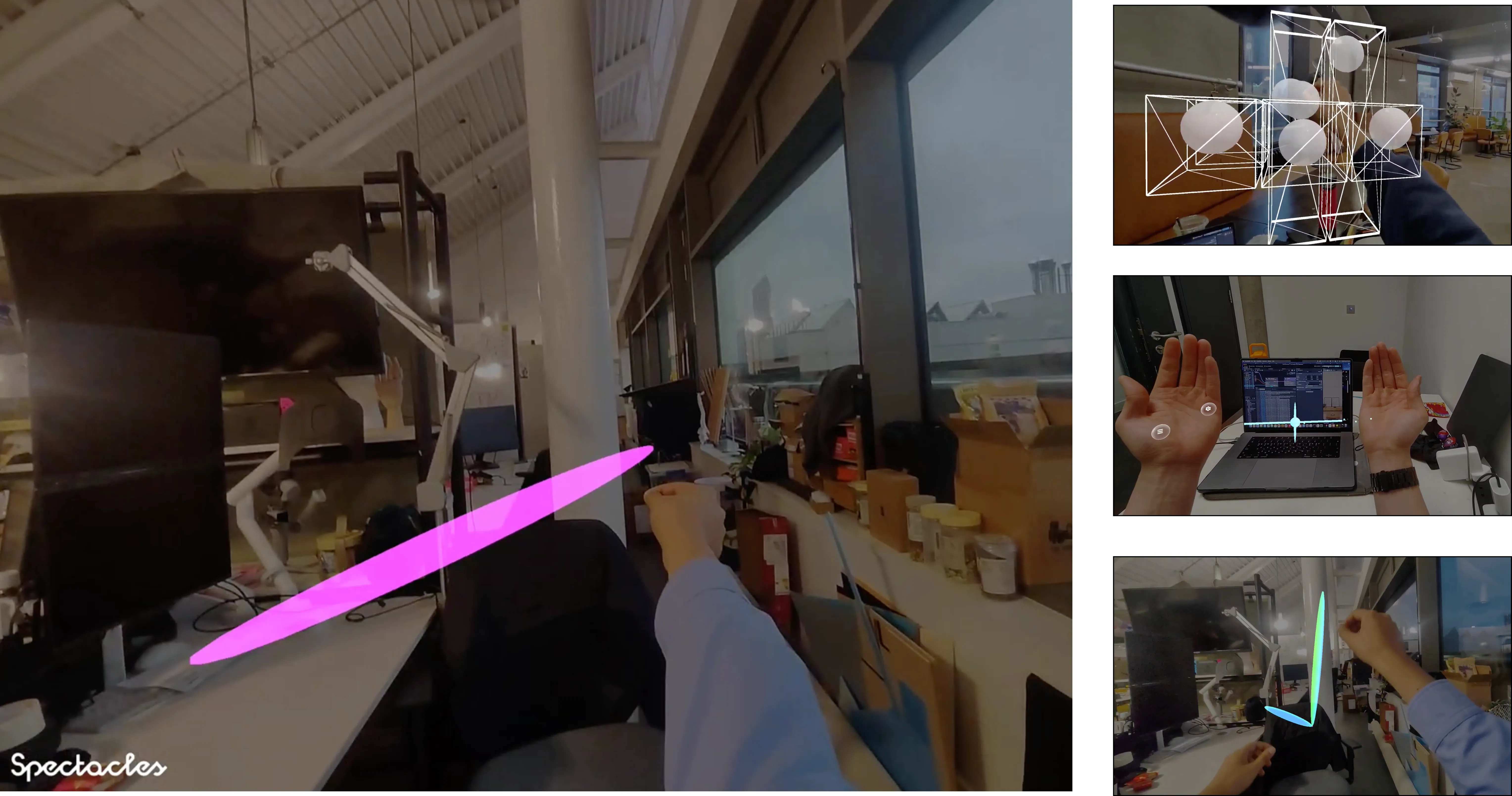
Spectacles POV footage from live prototyping sessions, pink planes, bounding boxes, hand tracking and gesture recognition tested on-device in the studio
prototyping
All prototyping is done directly in Lens Studio and tested on-device with the Spectacles. The footage is from live sessions in the studio, bounding boxes around recognised objects, hand tracking dots on palm centres, directional arrows for gesture confirmation. Everything is tested spatially rather than on a screen, because the experience only makes sense when you're standing inside it.
This is active work in progress. The research continues through the Snap x RCA collaboration and is evolving as new Spectacles capabilities become available. More to come.